
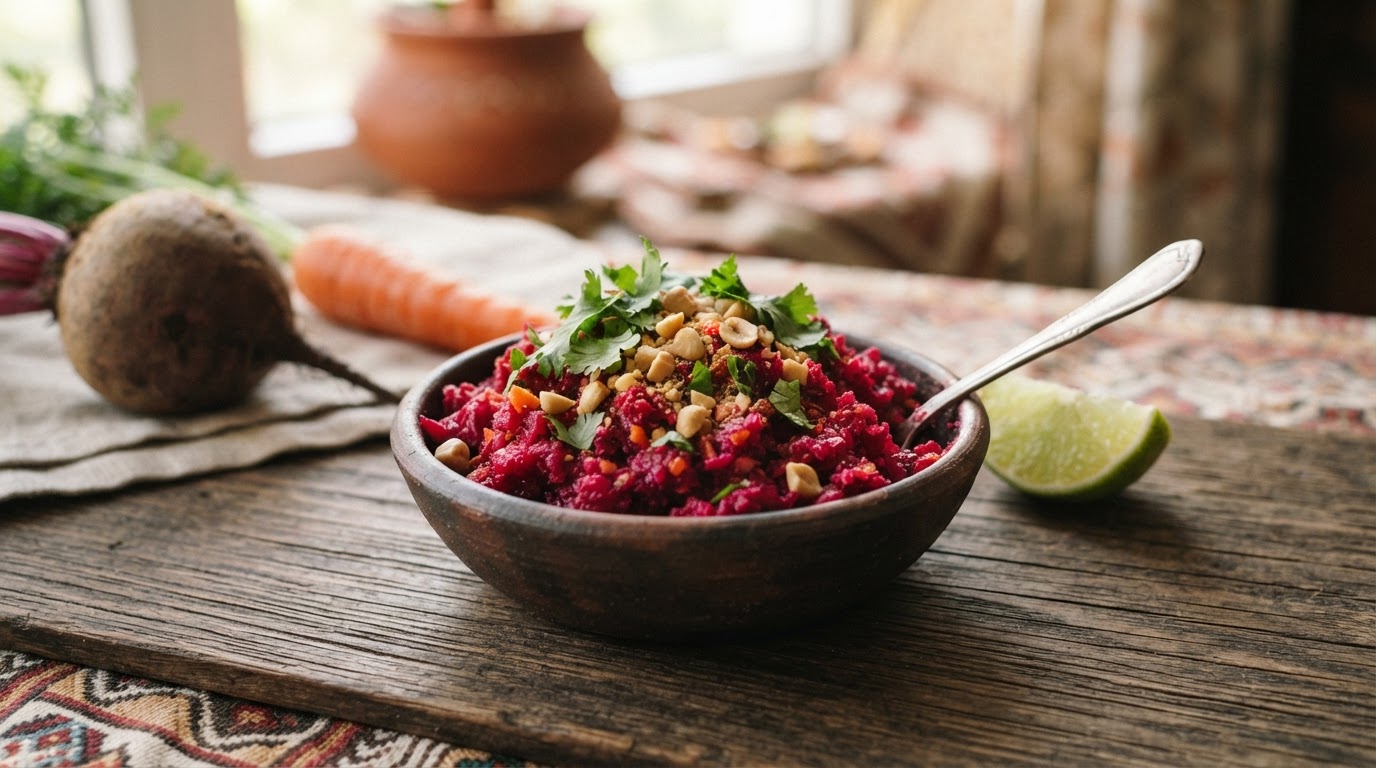
Fresh beetroot and carrot minced with roasted peanuts, lime, cumin and cilantro for a bright, crunchy onion-free chutney. Prepare this small accompaniment alongside a main dish for a Hare Krishna meal.
A fresh vegetable chutney rather than a cooked sauce
This preparation uses raw roots and crushed roasted peanuts for a relish-like texture. It differs from a grated vegetable salad because the ingredients are finely minced and served as a small condiment. Lime and the two ground spices emphasize the vegetables' natural flavor. There is no need for onion, garlic or a ready-made seasoning mix.
Preparing the roots
Choose firm beetroot and carrots without damaged areas. Peel them, cut them into small pieces and wash hands and equipment after handling the beetroot because its pigment stains. A food processor makes the pieces more uniform than a blender. Add the peanuts first so they are crushed without leaving very large fragments.
Control texture and heat
Pulse in short bursts. Continuous blending can turn the vegetables into a watery puree and heat the mixture. Use unsalted roasted peanuts so the measured salt is meaningful. For a gentle chutney, omit the chili entirely. Add lime juice after mincing, then mix well so the acidity reaches every portion.
Bhakti Thought
The colors of fresh vegetables offer a reminder to prepare meals with care and gratitude. Even a small spoonful can become part of a devotional meal.
PrintBeetroot Carrot Peanut Chutney
Fresh beetroot and carrot minced with roasted peanuts, lime, cumin and cilantro for a bright, crunchy onion-free chutney.
- Prep Time: 15 minutes
- Cook Time: 0 minutes
- Total Time: 15 minutes
- Yield: 8 servings 1x
- Category: Chutney
- Method: Food processor
- Cuisine: Indian
- Diet: Vegan
Ingredients
- 100 g peeled raw beetroot (about 3/4 cup chopped)
- 100 g peeled carrot (about 3/4 cup chopped)
- 2 tablespoons unsalted dry-roasted peanuts (18 g)
- 1 tablespoon fresh lime juice (15 ml)
- 1/4 teaspoon ground cumin
- 1/4 teaspoon ground coriander
- 1 small green chili, seeded, optional
- 2 tablespoons chopped cilantro (5 g)
- 1/4 teaspoon fine salt (1.5 g)
- 1 pinch ground black pepper
US & metric measurements — original 1× batch
Use either measurement, not both. Equivalents are approximate; original specified weights are preserved. Counts, optional quantities and amounts to taste remain as written. This reference is for the original batch; multiply both quantities if scaling the recipe.
100 g (approx. 3.53 oz by weight) peeled raw beetroot (about 3/4 cup (approx. 180 mL) chopped)
100 g (approx. 3.53 oz by weight) peeled carrot (about 3/4 cup (approx. 180 mL) chopped)
2 tablespoons unsalted dry-roasted peanuts (18 g)
1 tablespoon fresh lime juice (15 ml)
1/4 teaspoon (approx. 1.25 mL) ground cumin
1/4 teaspoon (approx. 1.25 mL) ground coriander
1 small green chili, seeded, optional
2 tablespoons chopped cilantro (5 g)
1/4 teaspoon fine salt (1.5 g)
1 pinch ground black pepper
Approximate kitchen conversions: NIST and ingredient-specific baking weights.
Instructions
- Wash, peel and finely dice the beetroot and carrot. Wash the cilantro and optional chili.
- Coarsely pulse the peanuts in a food processor, keeping some texture. Add beetroot and carrot and pulse until finely minced.
- Add lime juice, cumin, coriander, cilantro, salt, pepper and optional chili. Pulse briefly until the mixture is evenly combined but not a smooth puree.
- Transfer to a clean bowl and refrigerate until serving. Reserve an untouched portion for offering.
Notes
- Makes 8 portions. Use plain ingredients and individual spices without onion, garlic, eggs or mushrooms.
- Nutrition is estimated from representative ingredient composition and the measured fat and salt, with minor seasonings omitted. Kitchen testing pending.
- Keep refrigerated as directed; this is not a validated shelf-stable preserving recipe.
- Ingredient quantities and cooking times are editorial estimates; confirm through kitchen testing.
- Nutrition values are estimates per serving unless otherwise specified.
Nutrition
- Serving Size: 1/8 of prepared batch
- Calories: 24
- Sugar: 1.6 g
- Sodium: 93 mg
- Fat: 1.2 g
- Saturated Fat: 0.2 g
- Unsaturated Fat: 1 g
- Trans Fat: 0 g
- Carbohydrates: 3 g
- Fiber: 0.9 g
- Protein: 0.9 g
- Cholesterol: 0 mg
Serving suggestions
Serve a spoonful with rice, flatbread or pakoras. The crunchy texture provides contrast to smooth dal and creamy raita. For a gathering, keep the bowl cold and use a clean serving spoon rather than returning portions from individual plates. Offer a separate portion before distributing the rest.
Storage and texture
Keep the raw chutney refrigerated at 40°F (4°C) or below and use the same day for best quality. Salt draws liquid from the vegetables, so mix it shortly before serving and drain a little liquid if necessary. It is not suitable for shelf-stable storage, and freezing changes the raw vegetable texture.
Allergens and nutrition
Contains peanuts, a major food allergen. Check that any nuts and spices are unseasoned and suitable. The nutrition calculation assumes eight equal portions, and the ingredients are not cooked in oil. Do not substitute another nut when preparing food for a person with allergies unless its safety has been confirmed.
Frequently Asked Questions
Can I cook the beet first?
Yes, but it produces a softer cooked relish rather than the original raw texture.
Why is my chutney watery?
The vegetables may have been processed too long or salted too far in advance.
Can I omit the peanuts?
Yes, but the texture and nutritional values will change.
Can I use a blender?
A processor or fine hand chopping is better for retaining the coarse texture.