
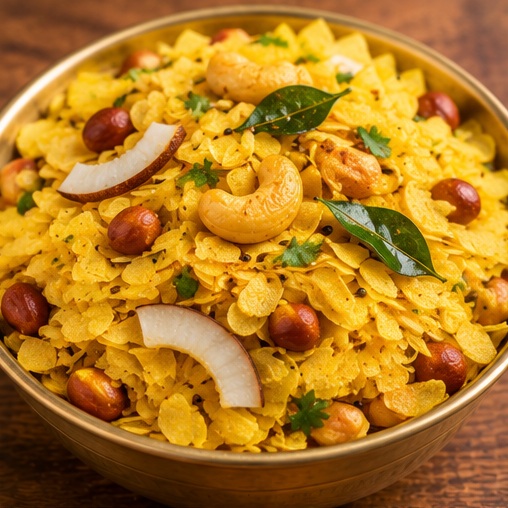
Thin poha dry-roasted until crisp and tossed with peanuts, cashews, curry leaves, turmeric and mustard, without onion or garlic.
An original measured recipe for home prasadam and suitable packed meals. All listed ingredients omit onion, garlic, eggs and mushrooms. Check packaged ingredients and follow your own temple's fasting guidance.
Chivda is different from breakfast poha
Breakfast poha is usually rinsed and cooked until tender. This snack uses dry thin flakes, which remain crisp after brief roasting. The coconut and nuts make a textured mixture without puffed rice or cornflakes.
Choose thin flattened rice
Use plain thin poha, not thick flakes designed for a moist breakfast. Do not wash the flakes for this dry snack. Roast small batches over gentle heat and check a cooled sample for crispness.
Cool before packing
Wet leaves or a hot sealed container introduce moisture. Dry curry leaves carefully before adding them to oil and allow the mixture to cool fully before sealing. Use clean dry utensils.
Bhakti Thought
Even a simple snack prepared with care can become an opportunity for devotional service. Set aside an untouched offering for Krishna before tasting, and share prasadam with gratitude.
PrintDry-Roasted Poha Chivda (Crunchy Flattened Rice Snack)
Thin poha dry-roasted until crisp and tossed with peanuts, cashews, curry leaves, turmeric and mustard, without onion or garlic.
- Prep Time: 10 minutes
- Cooling: 20 minutes
- Cook Time: 20 minutes
- Total Time: 50 minutes
- Yield: 8 servings 1x
- Category: Snack
- Method: Dry roasting and tempering
- Cuisine: Indian-inspired
- Diet: Vegan
Ingredients
- 200 g thin plain poha (flattened rice)
- 50 g plain unsalted peanuts
- 25 g plain cashews
- 20 g thin dried unsweetened coconut slices
- 2 tablespoons neutral oil (28 g)
- 1 teaspoon black mustard seeds
- 10–12 fresh curry leaves, washed and thoroughly dried
- 1/2 teaspoon turmeric
- 1/4 teaspoon mild ground chili, optional
- 1/2 teaspoon fine salt
US & metric measurements — original 1× batch
Use either measurement, not both. Equivalents are approximate; original specified weights are preserved. Counts, optional quantities and amounts to taste remain as written. This reference is for the original batch; multiply both quantities if scaling the recipe.
200 g (approx. 7.05 oz by weight) thin plain poha (flattened rice)
50 g (approx. 1.76 oz by weight) plain unsalted peanuts
25 g (approx. 0.88 oz by weight) plain cashews
20 g (approx. 0.71 oz by weight) thin dried unsweetened coconut slices
2 tablespoons neutral oil (28 g)
1 teaspoon (approx. 5 mL) black mustard seeds
10–12 fresh curry leaves, washed and thoroughly dried
1/2 teaspoon (approx. 2.5 mL) turmeric
1/4 teaspoon (approx. 1.25 mL) mild ground chili, optional
1/2 teaspoon (approx. 2.5 mL) fine salt
Approximate kitchen conversions: NIST and ingredient-specific baking weights.
Instructions
- Inspect thin poha and dry-roast it in batches in a broad clean skillet over low heat for 4–6 minutes per batch, stirring gently until crisp. Transfer to a clean tray.
- Heat oil on medium-low. Roast peanuts until lightly golden and cooked through; add cashews and coconut slices and stir until pale golden. Remove the nuts and coconut with a slotted spoon.
- In the remaining oil, allow mustard seeds to pop briefly. Reduce heat, carefully add dry curry leaves, then stir in turmeric and optional chili.
- Return the roasted ingredients, add crisp poha and salt and toss gently over low heat for 1–2 minutes. Avoid crushing the flakes.
- Spread on a tray and cool completely. Set aside an offering before tasting; portion into eight servings.
Notes
- Contains peanuts, cashews, coconut and mustard. Contains rice and legumes and is not suitable for grain-and-legume-free Ekadasi.
- Estimated nutrition per stated serving includes measured optional ingredients unless specified; actual values depend on brand, cooked yield and portion size. Not kitchen-tested.
- Ingredient quantities and cooking times are editorial estimates; confirm through kitchen testing.
- Nutrition values are estimates per serving unless otherwise specified.
Nutrition
- Serving Size: 1/8 of prepared batch
- Calories: 186
- Sugar: 1 g
- Sodium: 155 mg
- Fat: 9 g
- Saturated Fat: 2.5 g
- Unsaturated Fat: 6 g
- Trans Fat: 0 g
- Carbohydrates: 23 g
- Fiber: 2 g
- Protein: 4 g
- Cholesterol: 0 mg
Serving and tiffin suggestions
Offer a small portion and pack in a separate dry compartment away from chutneys and moist food.
Storage and safe serving
Keep fully cooled chivda in a clean dry airtight container at room temperature for up to one week. Discard if it becomes damp, rancid or moldy.
Nutrition and allergens
Contains peanuts, cashews, coconut and mustard. Contains rice and legumes and is not suitable for grain-and-legume-free Ekadasi. Nutrient values are approximate, not laboratory analyses.
Frequently Asked Questions
Should I wash poha for chivda?
No. Use clean packaged thin dry poha for this crisp mixture.
Why is my chivda chewy?
The flakes may not be roasted sufficiently, or they may have absorbed moisture.
Can I omit peanuts?
Yes. Use permitted alternative nuts or omit them; the nutrition changes.
Is this the same as masala murmure?
No. Chivda uses flattened rice rather than puffed rice.
Explore More Recipes
Masala Murmure (Spiced Puffed Rice)
Vegetable Moong Poha (Power Poha)
Ekadasi Makhana Chivda (Fox Nut, Coconut and Almond Snack Mix)