
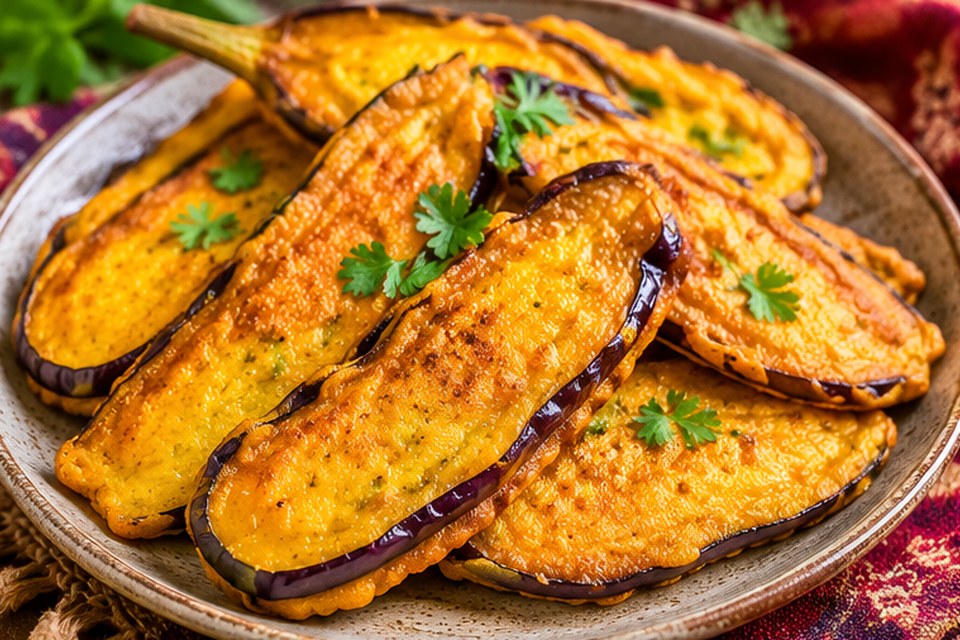
Beguni is a Bengali-style eggplant fritter in which a thin slice of aubergine becomes soft inside a crisp chickpea flour shell. This version uses rice flour and nigella seeds for texture and aroma without onion, garlic or commercial seasoning mixes. It makes a satisfying starter for a vegetarian prasadam meal.
Why thin slices matter
The eggplant should become completely tender by the time the batter turns golden. Thin slices cook more evenly than thick rounds, which may remain firm while the coating darkens. A medium eggplant with a firm skin is easier to slice consistently; there is no need to peel it. Blot moisture from each piece so it does not interfere with the batter.
Choosing the batter ingredients
Besan provides the main structure, while a little rice flour adds a delicate crunch. Whisk the water into the dry ingredients gradually. The batter should coat a spoon without running off immediately or forming a thick dough. Nigella seeds supply a gentle, distinctive aroma; they are not the same as onion seeds despite occasional misleading market names.
Frying in small batches
Crowding the pan lowers the fat temperature and makes fritters greasy. Keep the pieces separate, turn only when the first side has set, and let the temperature recover between batches. A rack keeps both sides crisp better than a pile of hot fritters on a plate.
Bhakti Thought
Preparing a simple vegetable with attention and care is a form of service. Offer the first portion with gratitude, then share the rest while it is still warm.
PrintBengali Beguni (Eggplant Fritters)
Crisp Bengali beguni features thin eggplant slices in a seasoned chickpea flour and rice flour batter, fried in ghee without onion or garlic.
- Prep Time: 20 minutes
- Batter resting: 15 minutes
- Cook Time: 25 minutes
- Total Time: 60 minutes
- Yield: 6 servings 1x
- Category: Appetizer
- Method: Shallow frying
- Cuisine: Bengali
- Diet: Vegetarian
Ingredients
- 1 medium eggplant (about 450 g)
- 1 cup chickpea flour (besan; about 92 g)
- 1 tablespoon rice flour (10 g)
- 3/4 cup cold water (180 ml), plus up to 2 tablespoons if needed
- 1/2 teaspoon nigella seeds (kalonji)
- 1/2 teaspoon ground turmeric
- 1/4 teaspoon mild red chili powder
- 3/4 teaspoon fine salt
- 1/2 cup ghee (about 110 g), for frying; approximately 40 g retained in the finished batch
US & metric measurements — original 1× batch
Use either measurement, not both. Equivalents are approximate; original specified weights are preserved. Counts, optional quantities and amounts to taste remain as written. This reference is for the original batch; multiply both quantities if scaling the recipe.
1 medium eggplant (about 450 g (approx. 15.87 oz by weight))
1 cup (approx. 85 g) chickpea flour (besan; about 92 g (approx. 3.25 oz by weight))
1 tablespoon rice flour (10 g)
3/4 cup cold water (180 ml), plus up to 2 tablespoons (approx. 30 mL) if needed
1/2 teaspoon (approx. 2.5 mL) nigella seeds (kalonji)
1/2 teaspoon (approx. 2.5 mL) ground turmeric
1/4 teaspoon (approx. 1.25 mL) mild red chili powder
3/4 teaspoon (approx. 3.75 mL) fine salt
1/2 cup ghee (about 110 g), for frying; approximately 40 g (approx. 1.41 oz by weight) retained in the finished batch
Approximate kitchen conversions: NIST and ingredient-specific baking weights.
Instructions
- Rinse the eggplant, trim off the stem and cut lengthwise into slices approximately 1/8–1/4 inch (approx. 0.64 cm) (3–5 mm (approx. 0.2 in)) thick. Cut long slices in half and blot them dry.
- Whisk the chickpea and rice flours, nigella, turmeric, chili and salt. Slowly add the measured cold water, whisking to a smooth coating batter. Rest for 15 minutes, then whisk again. Add extra water only if the batter is too thick to coat the slices evenly.
- Heat enough ghee to cover the base of a heavy frying pan by about 1/4 inch (6 mm), maintaining 350°F (175°C). Do not let the fat smoke.
- Dip each slice in batter, allow excess to drip off and lower it carefully into the hot ghee. Fry a few pieces at a time for 2–3 minutes per side, until the coating is golden and the eggplant is tender.
- Drain on a wire rack. Maintain the frying temperature for the remaining batches, replenishing ghee if necessary. Reserve a clean portion for offering before serving.
Notes
- Choose a firm, glossy eggplant; blot the slices before battering.
- Rice flour helps the coating crisp. Use a thermometer for consistent frying.
- Contains milk-derived ghee. For a vegan version, use a neutral frying oil instead.
- Nutrition assumes approximately 40 g of ghee absorbed in six servings. Actual absorption varies.
- Ingredient quantities and cooking times are editorial estimates; confirm through kitchen testing.
- Nutrition values are estimates per serving unless otherwise specified.
Nutrition
- Serving Size: 1/6 of the batch
- Calories: 145
- Sugar: 4.3 g
- Sodium: 300 mg
- Fat: 7.7 g
- Saturated Fat: 4.2 g
- Unsaturated Fat: 3.1 g
- Trans Fat: 0.2 g
- Carbohydrates: 14.8 g
- Fiber: 3.9 g
- Protein: 4.2 g
- Cholesterol: 17 mg
Serving ideas
Serve beguni with rice, dal or a selection of vegetarian starters. It is particularly suitable when you want a simple fried vegetable alongside a more substantial dish. A homemade coriander chutney or a mildly spiced yogurt accompaniment can add contrast; ensure every accompaniment is free of onion and garlic.
Making ahead and reheating
The batter can rest briefly while you slice the eggplant, but cut vegetables are best prepared shortly before cooking. Refrigerate leftovers in a covered container within two hours, and use within three days. Reheat on a rack in an oven at 375°F (190°C) until hot and crisp rather than microwaving.
Dietary and nutrition notes
The main batter uses chickpea and rice flours. For someone avoiding gluten, verify both flours and avoid cross-contact in the frying equipment. Ghee is milk-derived and is not vegan. The nutrition values are estimates for one-sixth of the batch, based on typical ingredient composition and assumed fat uptake.
Frequently Asked Questions
Can I make beguni without rice flour?
Yes. Replace it with besan; the coating will generally be less crisp.
Why is my eggplant fritter oily?
Oil or ghee that is too cool, wet vegetables and overcrowding can all increase oil absorption.
Can I bake beguni?
A lightly oiled baking tray can produce a different baked eggplant snack, but the wet batter will not behave exactly like a fried coating.
Is nigella the same as onion?
No. Nigella is the seed of Nigella sativa, not a member of the onion family.