
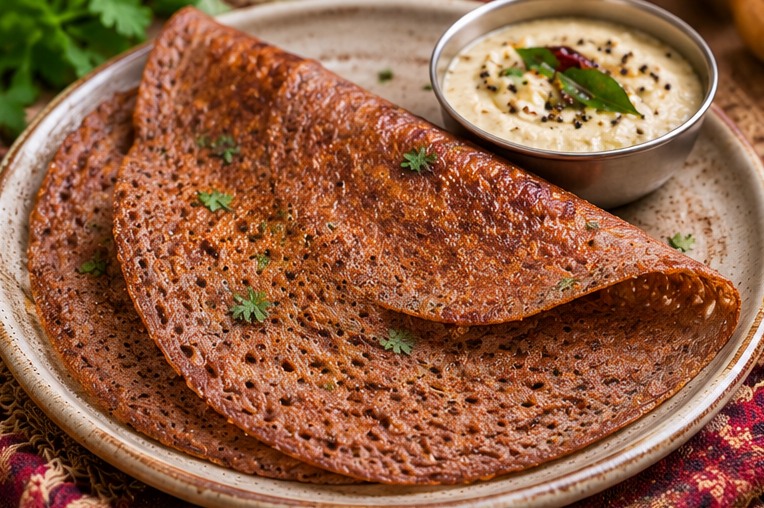
Ragi dosa is a South Indian-style breakfast crepe made with finger millet flour, rice and urad dal. The fermented batter gives a pleasantly tangy flavor, and the millet lends the crepe its characteristic brown color. The preparation contains no onion, garlic, eggs or mushrooms.
What makes ragi dosa different from plain dosa?
Finger millet, known as ragi, replaces much of the rice normally used in dosa batter. It adds an earthy flavor and a darker color. Rice and urad dal remain important for structure and fermentation; replacing all the rice with millet would create a different batter. Buy fresh, finely milled ragi flour and store it in a cool, dry container.
Soaking and grinding
Soak the rice and lentils separately so each can be ground to its own ideal consistency. Urad dal should become airy and smooth, while rice needs a relatively fine texture. Use water in small increments to prevent a batter that becomes too loose to spread. Whisk in millet flour carefully to eliminate dry pockets.
Fermenting and cooking
Use a container with sufficient headroom and let the batter develop at a moderate temperature. The goal is a lightly aerated, pleasantly tangy mixture, not a set clock time regardless of conditions. A moderately hot griddle is essential: if the surface is too hot, the batter may set before it can spread. If a crepe tears, adjust the consistency and cook the next one a little longer.
Bhakti Thought
Preparing a batter the night before is a small act of foresight. In devotional cooking, that patience becomes part of the service offered with the finished meal.
PrintRagi Dosa (Finger Millet Crepes)
Fermented finger millet, rice and urad dal crepes cooked on a hot griddle with a little ghee. No onion or garlic.
- Prep Time: 25 minutes
- Soaking and fermentation: 720 minutes
- Cook Time: 30 minutes
- Total Time: 775 minutes
- Yield: 6 servings 1x
- Category: Breakfast
- Method: Griddle
- Cuisine: South Indian
- Diet: Vegetarian
Ingredients
- 1/2 cup split, skinned urad dal (100 g)
- 1/2 cup uncooked rice (100 g)
- 1 1/2 cups ragi flour (finger millet flour; 180 g)
- 1 teaspoon fine salt (6 g)
- 1 small green chili, minced, optional
- About 1 1/2 cups water (360 ml), for grinding and thinning, as needed
- 1 tablespoon ghee (14 g), for cooking
- Additional clean water for soaking
US & metric measurements — original 1× batch
Use either measurement, not both. Equivalents are approximate; original specified weights are preserved. Counts, optional quantities and amounts to taste remain as written. This reference is for the original batch; multiply both quantities if scaling the recipe.
1/2 cup split, skinned urad dal (100 g)
1/2 cup uncooked rice (100 g)
1 1/2 cups (approx. 360 mL) ragi flour (finger millet flour; 180 g (approx. 6.35 oz by weight))
1 teaspoon fine salt (6 g)
1 small green chili, minced, optional
About 1 1/2 cups water (360 ml), for grinding and thinning, as needed
1 tablespoon ghee (14 g), for cooking
Additional clean water for soaking
Approximate kitchen conversions: NIST and ingredient-specific baking weights.
Instructions
- Rinse the rice and urad dal separately. Soak each in plenty of clean water for 4 hours, then drain. Refrigerate during soaking if the kitchen is very warm.
- Grind the dal with a little of the measured water until fluffy and smooth. Grind the rice separately to a fine paste, adding water gradually. Transfer both to a large bowl.
- Whisk the ragi flour into the combined paste, adding enough of the measured water to produce a thick but pourable batter. Stir in salt. Leave space for expansion, cover loosely and ferment for about 8 hours at a comfortably warm room temperature (approximately 75–85°F (24–29°C) (24–29°C (75–84°F)) (24–29°C (75–84°F) (75–84°F (24–29°C))) / 24–29°C (75–84°F) (75–84°F (24–29°C)) (75–84°F (24–29°C) (24–29°C (75–84°F)))), until aerated and pleasantly tangy. Refrigerate once fermented; discard batter showing mold, unusual discoloration or unpleasant odor.
- Stir gently, adding a little water if needed so a ladleful will spread. Heat a seasoned griddle over medium heat and lightly grease with ghee. Spread about 1/4 cup of batter into a thin circle. Sprinkle with a few pieces of optional chili.
- Cook for 2–3 minutes until the top is set and the edges release. Flip briefly if desired. Repeat to make about 12 small dosas. Reserve an untouched portion for offering before serving.
Notes
- The 1:1:3 ratio of dal, rice and millet flour is expressed by volume; weights are standardized estimates.
- Fermentation speed varies by temperature. Do not use an actively heated oven; keep batter covered and refrigerate when ready.
- Contains milk-derived ghee. Use a neutral oil for a vegan version.
- Serving estimate: two dosas; chutneys and other sides are excluded.
- Ingredient quantities and cooking times are editorial estimates; confirm through kitchen testing.
- Nutrition values are estimates per serving unless otherwise specified.
Nutrition
- Serving Size: 1/6 of prepared batch
- Calories: 235
- Sugar: 0.8 g
- Sodium: 395 mg
- Fat: 3.5 g
- Saturated Fat: 1.5 g
- Unsaturated Fat: 1.7 g
- Trans Fat: 0 g
- Carbohydrates: 43 g
- Fiber: 5 g
- Protein: 8 g
- Cholesterol: 5 mg
Serving suggestions
Serve fresh ragi dosas with a suitable coconut chutney or vegetable preparation, without onion or garlic. They make a substantial breakfast alongside a caffeine-free drink. At a gathering, prepare the batter ahead and cook small batches shortly before the meal, so the crepes remain crisp at the edges.
Storage and reheating
Refrigerate fermented batter in a clean covered container and use it within two days. Refrigerate cooked leftovers within two hours and use within three days. Reheat on a dry griddle until hot; reheated dosas will be softer than freshly cooked ones. Do not leave prepared batter warm after fermentation has finished.
Dietary considerations
This preparation uses rice and lentils and is not intended for the usual grain-and-legume-free Ekadasi observance. Ghee is milk-derived; neutral oil makes a vegan variation. Rice, dal and ragi do not inherently contain gluten, but check processing and cross-contact when necessary. Nutrition is estimated from dry ingredient weights and the measured cooking fat.
Frequently Asked Questions
Can ragi flour replace the rice entirely?
Not in this formula. Rice and urad dal help form a spreadable fermented batter.
Why is the dosa darker than regular dosa?
Finger millet naturally gives the batter a brown color.
Can I prepare the batter the day before?
Yes. Allow it to ferment, then refrigerate until you are ready to cook.
Why does my dosa stick?
Check the pan seasoning and heat, use a light coating of ghee and let the underside set before lifting.