
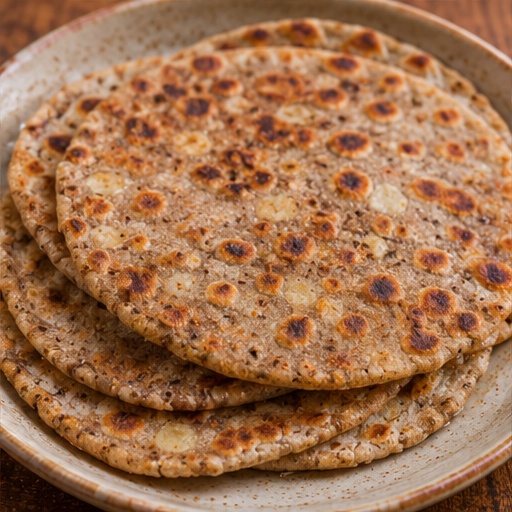
Soft griddle-cooked buckwheat flatbreads bound with mashed potato and brushed with fresh ghee, without wheat flour.
For devotees taking permitted food on Ekadasi, not those observing a complete fast. Confirm amaranth, buckwheat, water chestnut flour, particular vegetables, nuts, dairy, sweeteners and optional seasonings with your temple. Use pure ingredients, clean equipment free of grain and legume residues and fresh ghee; do not reuse grain-frying fat. Omit optional seasonings if your practice excludes them.
Buckwheat paratha without wheat
Kuttu is buckwheat, not a variety of wheat. This flatbread uses pure buckwheat flour and cooked potato as a binder because the dough lacks the elastic gluten network of wheat. The resulting bread is tender and more delicate than an ordinary paratha. Confirm that buckwheat is permitted in your Ekadasi observance.
Use dry smooth potato
Boil potato until tender, drain and allow steam to escape before mashing. The potato should supply most of the moisture. Add water in small increments only if the flour mixture will not hold together. Resting allows the flour to hydrate, but kneading hard will not create wheat-like elasticity.
Shape between parchment
Pat rather than stretching the dough, and keep the discs relatively small. Clean parchment helps transfer the soft bread without needing ordinary dusting flour. Cook over moderate heat, flip with a wide spatula and ensure both sides are fully cooked. A little fresh ghee softens the finish.
Bhakti Thought
Ekadasi is an opportunity for simplicity and greater remembrance of Krishna. Prepare only the food permitted by your observance, reserve a clean portion for offering before tasting, and share prasadam with gratitude.
PrintEkadasi Kuttu Paratha (Buckwheat Potato Flatbread)
Soft griddle-cooked buckwheat flatbreads bound with mashed potato and brushed with fresh ghee, without wheat flour.
- Prep Time: 20 minutes
- Dough resting: 10 minutes
- Cook Time: 25 minutes
- Total Time: 55 minutes
- Yield: 6 servings 1x
- Category: Bread
- Method: Griddle cooking
- Cuisine: Indian-inspired
- Diet: Vegetarian
Ingredients
- 1 1/2 cups pure buckwheat flour (180 g), plus a little for dusting if needed
- 180 g cooked peeled potato, mashed smooth
- 1/4 teaspoon pure rock salt (1.5 g), optional
- 1–4 tablespoons drinking water (15–60 ml), only as needed
- 1 tablespoon fresh pure ghee (14 g), for cooking
US & metric measurements — original 1× batch
Use either measurement, not both. Equivalents are approximate; original specified weights are preserved. Counts, optional quantities and amounts to taste remain as written. This reference is for the original batch; multiply both quantities if scaling the recipe.
1 1/2 cups pure buckwheat flour (180 g), plus a little for dusting if needed
180 g (approx. 6.35 oz by weight) cooked peeled potato, mashed smooth
1/4 teaspoon pure rock salt (1.5 g), optional
1–4 tablespoons drinking water (15–60 ml), only as needed
1 tablespoon fresh pure ghee (14 g), for cooking
Approximate kitchen conversions: NIST and ingredient-specific baking weights.
Instructions
- Mix pure buckwheat flour, potato and optional rock salt. Knead lightly, adding water by the teaspoon until a soft, cohesive dough forms.
- Cover and rest ten minutes. Divide into six equal portions.
- Pat each portion between two pieces of clean parchment into a disc about 13 cm (5 inches) across. If dusting, use only verified pure buckwheat.
- Cook on a clean griddle over medium-low heat, turning after the first side is set. Brush with a little fresh ghee and cook until both sides show golden spots and the center is fully cooked.
- Keep finished parathas covered briefly to retain softness. Reserve an offering before serving warm.
Notes
- Makes 6 reference portions. For devotees taking permitted food on Ekadasi, not those observing a complete fast. Confirm amaranth, buckwheat, water chestnut flour, particular vegetables, nuts, dairy, sweeteners and optional seasonings with your temple. Use pure ingredients, clean equipment free of grain and legume residues and fresh ghee; do not reuse grain-frying fat. Omit optional seasonings if your practice excludes them.
- Allergens: Milk-derived ghee.
- Nutrition estimated from representative ingredient composition and measured quantities; minor seasonings omitted. Recipe proportions, times and yield have not been kitchen-tested.
- Ingredient quantities and cooking times are editorial estimates; confirm through kitchen testing.
- Nutrition values are estimates per serving unless otherwise specified.
Nutrition
- Serving Size: 1/6 of prepared batch
- Calories: 148
- Sugar: 1 g
- Sodium: 103 mg
- Fat: 3.3 g
- Saturated Fat: 1.7 g
- Unsaturated Fat: 1.6 g
- Trans Fat: 0.1 g
- Carbohydrates: 27.2 g
- Fiber: 3.5 g
- Protein: 4.4 g
- Cholesterol: 6 mg
Serving suggestions
Serve one or two small parathas with a permitted potato, coconut or yogurt preparation. Use fresh ghee and avoid grain cross-contact.
Storage and reheating
Refrigerate within two hours, use within three days and reheat until steaming hot. Rewarm on a griddle and keep briefly covered so the bread does not dry out.
Dietary and nutrition notes
Contains milk-derived ghee. Buckwheat is naturally free of wheat gluten, but commercial flour may have grain cross-contact. The estimates exclude any extra dusting flour and use six equal breads.
Frequently Asked Questions
Is kuttu the same as wheat?
No, buckwheat is botanically different.
Why does the dough crack?
Add a little mashed potato or water and pat smaller discs.
Can I use wheat flour for dusting?
No, not on a grain-free fast.
Can I omit ghee?
Yes, use a clean dry nonstick griddle; the bread may be drier.
Explore More Recipes
Ekadasi Farali Dosa (Buckwheat and Tapioca Crepes)
Related Ekadasi recipe: For a dry potato accompaniment with cumin where permitted, try Jeera Aloo.