
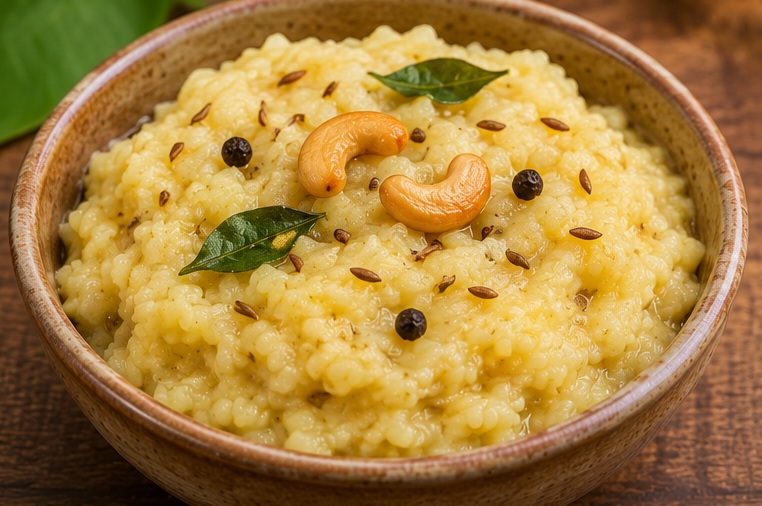
Soft rice and yellow moong dal finished with ghee, cracked pepper, cumin, ginger and toasted cashews.
An independently measured regional adaptation for home prasadam cooking. All listed ingredients omit onion, garlic, eggs and mushrooms. Follow your own temple's guidance for fasting and worship.
What is ven pongal?
Ven pongal is a savory South Indian rice and split moong preparation with a soft texture and fragrant ghee-pepper seasoning. It is distinct from sweet pongal and from the millet-free amaranth pongal in the Ekadasi collection.
Cook to a soft consistency
Use enough water for the rice and dal to soften fully. Add water during cooking if needed; this is intentionally softer than a fluffy pilaf.
Finish with fragrant ghee
Toast cashews separately so they do not burn while the spices heat. Briefly warm cumin, ginger and pepper in ghee and add the mixture at the end.
Bhakti Thought
Regional traditions provide many ways to prepare and share a meal with devotion. Set aside an untouched offering for Krishna before tasting and distribute prasadam with gratitude.
PrintSouth Indian Ven Pongal (Savory Rice and Moong Dal)
Soft rice and yellow moong dal finished with ghee, cracked pepper, cumin, ginger and toasted cashews.
- Prep Time: 10 minutes
- Cook Time: 35 minutes
- Total Time: 45 minutes
- Yield: 4 servings 1x
- Category: Breakfast
- Method: Simmering
- Cuisine: Indian regional-inspired
- Diet: Vegetarian
Ingredients
- 150 g uncooked short- or medium-grain white rice
- 75 g dry split yellow moong dal
- 900 ml drinking water, plus more as needed
- 20 g cashews
- 2 tablespoons pure ghee (28 g)
- 1 teaspoon cumin seeds
- 1/2 teaspoon coarsely crushed black pepper
- 8 g fresh ginger, finely chopped
- 8 fresh curry leaves, washed and dried
- 1/2 teaspoon fine salt
US & metric measurements — original 1× batch
Use either measurement, not both. Equivalents are approximate; original specified weights are preserved. Counts, optional quantities and amounts to taste remain as written. This reference is for the original batch; multiply both quantities if scaling the recipe.
150 g (approx. 5.29 oz by weight) uncooked short- or medium-grain white rice
75 g (approx. 2.65 oz by weight) dry split yellow moong dal
900 ml (approx. 3.75 US cups) drinking water, plus more as needed
20 g (approx. 0.71 oz by weight) cashews
2 tablespoons pure ghee (28 g)
1 teaspoon (approx. 5 mL) cumin seeds
1/2 teaspoon (approx. 2.5 mL) coarsely crushed black pepper
8 g (approx. 0.28 oz by weight) fresh ginger, finely chopped
8 fresh curry leaves, washed and dried
1/2 teaspoon (approx. 2.5 mL) fine salt
Approximate kitchen conversions: NIST and ingredient-specific baking weights.
Instructions
- Dry-toast moong dal gently for 2–3 minutes until fragrant, without darkening. Rinse rice and dal together.
- Combine rice, dal and water in a heavy saucepan. Bring to a gentle boil, then simmer covered loosely for 25–35 minutes, stirring occasionally and adding hot water as needed, until both are very soft.
- Lightly mash the mixture to a soft, spoonable texture and add salt.
- Warm ghee in a small pan, toast cashews until golden and remove. Add cumin, pepper, ginger and dry curry leaves briefly; stir into the pongal and return cashews.
- Reserve an untouched offering and serve warm.
Notes
- Contains milk-derived ghee, cashews and mung beans. Contains rice and legumes and is not an Ekadasi fasting recipe.
- Nutrition estimates per stated serving use representative ingredients and include measured optional ingredients; actual values depend on brands and yield. Not kitchen-tested.
- Ingredient quantities and cooking times are editorial estimates; confirm through kitchen testing.
- Nutrition values are estimates per serving unless otherwise specified.
Nutrition
- Serving Size: 1/4 of prepared batch
- Calories: 305
- Sugar: 1 g
- Sodium: 300 mg
- Fat: 10 g
- Saturated Fat: 5 g
- Unsaturated Fat: 4 g
- Trans Fat: 0.2 g
- Carbohydrates: 45 g
- Fiber: 4 g
- Protein: 8 g
- Cholesterol: 18 mg
Serving suggestions
Serve with a little coconut chutney or vegetable sambar as part of a suitable breakfast or feast.
Storage and safe serving
Cool promptly in shallow containers, refrigerate within two hours and use within three days. Reheat until steaming hot with a little water.
Nutrition and allergens
Contains milk-derived ghee, cashews and mung beans. Contains rice and legumes and is not an Ekadasi fasting recipe. Nutrient values are approximate, not laboratory analyses.
Frequently Asked Questions
Is ven pongal sweet?
No, it is savory.
Can I make it without cashews?
Yes; omit them if desired.
Why did the pongal thicken?
Rice and dal absorb water as they cool. Add hot water during reheating.
Can I use an Ekadasi substitute?
See the site's savory amaranth pongal for a separately developed, locally permitted alternative.