
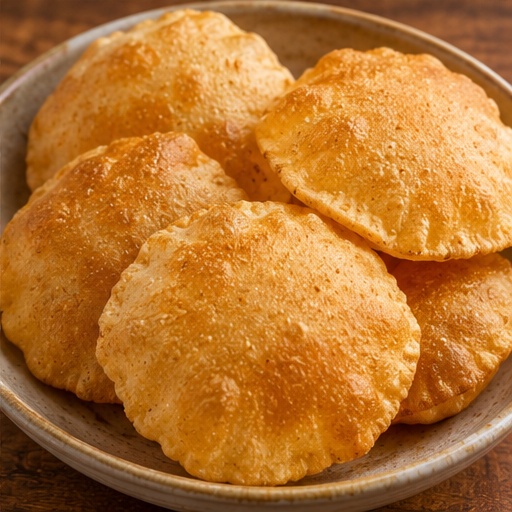
Small amaranth-flour and potato puris fried in fresh pure ghee, without wheat, rice flour or legumes.
For devotees taking permitted food on Ekadasi, not those observing a complete fast. Confirm amaranth, buckwheat, water chestnut flour, particular vegetables, nuts, dairy, sweeteners and optional seasonings with your temple. Use pure ingredients, clean equipment free of grain and legume residues and fresh ghee; do not reuse grain-frying fat. Omit optional seasonings if your practice excludes them.
A fasting bread made with amaranth
Rajgira puri is a small fried bread made from pure amaranth flour. This version adds cooked potato to help the delicate dough hold together without wheat. Amaranth has no gluten network, so these puris may puff only partially. They are not guaranteed to resemble the balloon-shaped wheat puri.
Make firm discs
Weigh the flour and use dry mashed potato. A soft sticky dough absorbs more surface fat and is harder to transfer. Add only the water required for binding. Pat small discs between parchment and smooth the edges. Keep any uncooked pieces covered to avoid cracking.
Fry safely in fresh ghee
Use a stable deep pan, a thermometer and plenty of headspace. The discs should not carry droplets of water into hot fat. Lower one carefully and avoid crowding. If fat smokes, turn off the heat safely. Never use water on a grease fire. Children should not help near hot fat. Fry until the centers cook through and drain promptly.
Bhakti Thought
Ekadasi is an opportunity for simplicity and greater remembrance of Krishna. Prepare only the food permitted by your observance, reserve a clean portion for offering before tasting, and share prasadam with gratitude.
PrintEkadasi Rajgira Puri (Amaranth Potato Puffed Bread)

Small amaranth-flour and potato puris fried in fresh pure ghee, without wheat, rice flour or legumes.
- Prep Time: 20 minutes
- Dough resting: 10 minutes
- Cook Time: 20 minutes
- Total Time: 50 minutes
- Yield: 8 servings 1x
- Category: Bread
- Method: Frying
- Cuisine: Indian-inspired
- Diet: Vegetarian
Ingredients
- 1 cup pure amaranth flour (rajgira; 120 g)
- 120 g cooked peeled potato, mashed smooth
- 1/4 teaspoon pure rock salt (1.5 g), optional
- 1–3 tablespoons drinking water (15–45 ml), as needed
- Fresh pure ghee for frying, sufficient for a safe shallow-depth frying setup (estimated 24 g absorbed across 8 puris)
US & metric measurements — original 1× batch
Use either measurement, not both. Equivalents are approximate; original specified weights are preserved. Counts, optional quantities and amounts to taste remain as written. This reference is for the original batch; multiply both quantities if scaling the recipe.
1 cup (approx. 240 mL) pure amaranth flour (rajgira; 120 g (approx. 4.23 oz by weight))
120 g (approx. 4.23 oz by weight) cooked peeled potato, mashed smooth
1/4 teaspoon pure rock salt (1.5 g), optional
1–3 tablespoons drinking water (15–45 ml), as needed
Fresh pure ghee for frying, sufficient for a safe shallow-depth frying setup (estimated 24 g (approx. 0.85 oz by weight) absorbed across 8 puris)
Approximate kitchen conversions: NIST and ingredient-specific baking weights.
Instructions
- Combine pure amaranth flour, potato and optional rock salt. Add water by the teaspoon to make a firm cohesive dough. Rest covered for ten minutes.
- Divide into eight equal pieces and pat between clean parchment into even discs about 8–9 cm (approx. 3.5 in) across and 3 mm (approx. 0.12 in) thick. Do not dust with wheat flour.
- Heat fresh pure ghee in a stable deep heavy saucepan to approximately 340–350°F (171–177°C) (171–177°C (340–351°F)) (171–177°C (340–351°F) (340–351°F (171–177°C))) (170–175°C (338–347°F) (338–347°F (170–175°C)) (338–347°F (170–175°C) (170–175°C (338–347°F)))), with ample headspace; do not fill the pan more than one-third. Use a thermometer and keep water away from the hot fat.
- Slide in one dry-surfaced disc carefully. Fry until set and lightly puffed, turning with a slotted spoon until golden and fully cooked. Remove to a rack or absorbent paper. Maintain the temperature and repeat in small batches. Never leave hot fat unattended.
- Reserve an untouched offering portion before serving warm. Allow remaining fat to cool safely; do not reuse it for Ekadasi if contaminated.
Notes
- Makes 8 reference portions. For devotees taking permitted food on Ekadasi, not those observing a complete fast. Confirm amaranth, buckwheat, water chestnut flour, particular vegetables, nuts, dairy, sweeteners and optional seasonings with your temple. Use pure ingredients, clean equipment free of grain and legume residues and fresh ghee; do not reuse grain-frying fat. Omit optional seasonings if your practice excludes them.
- Allergens: Milk-derived ghee.
- Nutrition estimated from representative ingredient composition and measured quantities; minor seasonings omitted. Recipe proportions, times and yield have not been kitchen-tested.
- Frying-fat absorption is estimated at 24 g per batch, not a measured value or the amount needed to fill the pan.
- Ingredient quantities and cooking times are editorial estimates; confirm through kitchen testing.
- Nutrition values are estimates per serving unless otherwise specified.
Nutrition
- Serving Size: 1/8 of prepared batch
- Calories: 96
- Sugar: 0.4 g
- Sodium: 75 mg
- Fat: 4.1 g
- Saturated Fat: 2.1 g
- Unsaturated Fat: 1.9 g
- Trans Fat: 0.1 g
- Carbohydrates: 12.8 g
- Fiber: 1.3 g
- Protein: 2.3 g
- Cholesterol: 8 mg
Serving suggestions
Serve a small portion with a permitted mild vegetable dish. Follow your temple's guidance about amaranth and fried foods on fasting days; this is an optional preparation.
Storage and reheating
Best fresh. Refrigerate cooked puris within two hours, consume within three days and reheat until steaming hot. Fried bread loses crispness during refrigeration.
Allergens and nutrition
Contains milk-derived ghee. The card assumes 24 g of frying fat retained for the entire batch; this is an editorial estimate, not the amount required in the pan. Actual absorption and calorie values vary.
Frequently Asked Questions
Why did my puri not puff?
Amaranth dough does not behave like wheat; even thickness and sufficient heat help.
Can I shallow-roast the discs instead?
Yes, cook through on a griddle; the result is closer to a flatbread.
Can I add wheat flour?
Not for this fasting adaptation.
Can I reuse frying fat?
Do not use fat previously exposed to grains or legumes.