
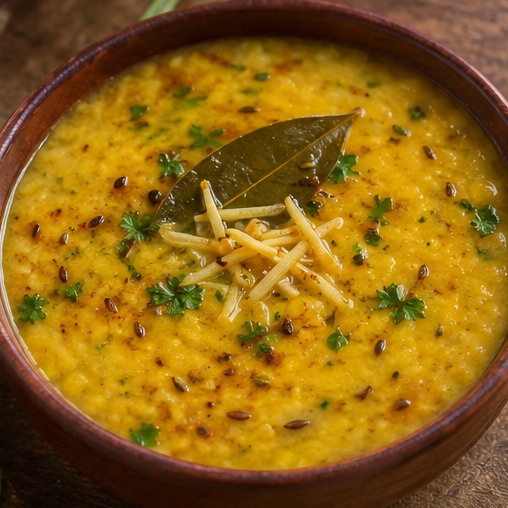
Dry-roasted yellow moong dal simmered with turmeric and finished with ginger, bay leaf and ghee. This dish is prepared without onion, garlic, eggs or mushrooms and can be offered as part of a vegetarian prasadam meal.
Why roast moong dal?
Dry roasting lends yellow lentils a nutty fragrance that distinguishes this preparation from plain moong dal. The objective is a pale golden color, not deep brown grains. Stir constantly over moderate heat because individual grains can scorch quickly. Use a heavy pan rather than a thin vessel that develops hot spots.
Rinsing and simmering roasted lentils
Cool the dal before rinsing. Add the measured water and turmeric and simmer gently until the lentils are fully tender. The liquid may need replenishing because evaporation differs with pan size. Use hot water in small increments and stir occasionally to prevent sticking, particularly near the end.
Finishing with ginger and bay leaf
The finishing tempering provides fragrance without onion or garlic. Use a modest amount of ghee and warm the ginger only until aromatic. Add the bay leaves and optional chili in the order given in the recipe. Avoid a prolonged fry, which can make the ginger bitter.
Bhakti Thought
Prepare a clean portion with care and offer it to Krishna before sharing the meal with others. Even a simple everyday dish can become an expression of devotional service.
PrintBhaja Muger Dal (Bengali Roasted Moong Dal)
Dry-roasted yellow moong dal simmered with turmeric and finished with ginger, bay leaf and ghee. No onion or garlic.
- Prep Time: 10 minutes
- Cook Time: 45 minutes
- Total Time: 55 minutes
- Yield: 4 servings 1x
- Category: Main Course
- Method: Stovetop
- Cuisine: Bengali
- Diet: Vegetarian
Ingredients
- 1 cup yellow split moong dal (200 g)
- 3 1/2 cups water (840 ml), plus more as needed
- 1/2 teaspoon turmeric
- 3/4 teaspoon fine salt (4.5 g)
- 1 teaspoon sugar (4 g), optional
- 1/2 teaspoon ground cumin
- 1/2 teaspoon ground coriander
- 2 teaspoons ghee (9 g)
- 2 Indian bay leaves
- 1 teaspoon grated ginger
- 1 small green chili, minced, optional
US & metric measurements — original 1× batch
Use either measurement, not both. Equivalents are approximate; original specified weights are preserved. Counts, optional quantities and amounts to taste remain as written. This reference is for the original batch; multiply both quantities if scaling the recipe.
1 cup yellow split moong dal (200 g)
3 1/2 cups water (840 ml), plus more as needed
1/2 teaspoon (approx. 2.5 mL) turmeric
3/4 teaspoon fine salt (4.5 g)
1 teaspoon sugar (4 g), optional
1/2 teaspoon (approx. 2.5 mL) ground cumin
1/2 teaspoon (approx. 2.5 mL) ground coriander
2 teaspoons ghee (9 g)
2 Indian bay leaves
1 teaspoon (approx. 5 mL) grated ginger
1 small green chili, minced, optional
Approximate kitchen conversions: NIST and ingredient-specific baking weights.
Instructions
- Dry-roast moong dal in a heavy saucepan over medium-low heat, stirring for 6–8 minutes until lightly golden and nutty smelling.
- Cool briefly, rinse gently and drain.
- Bring water to a boil with dal and turmeric. Reduce heat and simmer partially covered for 25–35 minutes until tender, stirring occasionally.
- Add salt, sugar if using, cumin and coriander. Adjust thickness with hot water.
- Heat ghee in a small skillet. Add bay leaves, ginger and optional chili; stir until fragrant. Pour into the dal and simmer briefly. Reserve a portion for offering.
Notes
- Makes four portions. Use unseasoned ingredients and spices without onion, garlic, eggs or mushrooms.
- Nutrition and cooking times are approximate; kitchen testing pending. Accompaniments excluded.
- Ingredient quantities and cooking times are editorial estimates; confirm through kitchen testing.
- Nutrition values are estimates per serving unless otherwise specified.
Nutrition
- Serving Size: 1/4 of the prepared batch
- Calories: 198
- Sugar: 4.3 g
- Sodium: 450 mg
- Fat: 2.9 g
- Saturated Fat: 1.6 g
- Unsaturated Fat: 1.2 g
- Trans Fat: 0.1 g
- Carbohydrates: 32.3 g
- Fiber: 8.2 g
- Protein: 12 g
- Cholesterol: 6 mg
Serving suggestions
Serve with plain basmati rice, chapati and a seasonal sabji. A slightly thinner consistency works well with rice; a thicker dal pairs with flatbread. The roasted flavor complements a mild vegetable preparation. Reserve the offering first.
Making ahead and reheating
Roast the dry dal in advance if desired, then cool and store it airtight. Refrigerate cooked dal within two hours and consume within three days. Reheat with a little water until steaming hot, since dal thickens in the refrigerator. Stir frequently to prevent scorching.
Dietary notes
Moong is a legume and is not suitable for the usual Ekadasi fast. Ghee is milk-derived; plant oil makes a vegan variation. The estimated nutrient values assume four portions and include the optional sugar.
Frequently Asked Questions
Can I skip roasting?
Yes, but the result will lack the characteristic roasted aroma.
Must I soak split moong?
No, it typically softens without soaking.
Why does the dal taste bitter?
The dal or spices may have scorched. Use moderate heat.
Can I omit sugar?
Yes.
Explore More Recipes
Related tiffin recipe: For a flattened-rice tiffin using cooked mung beans, try Vegetable Moong Poha.