
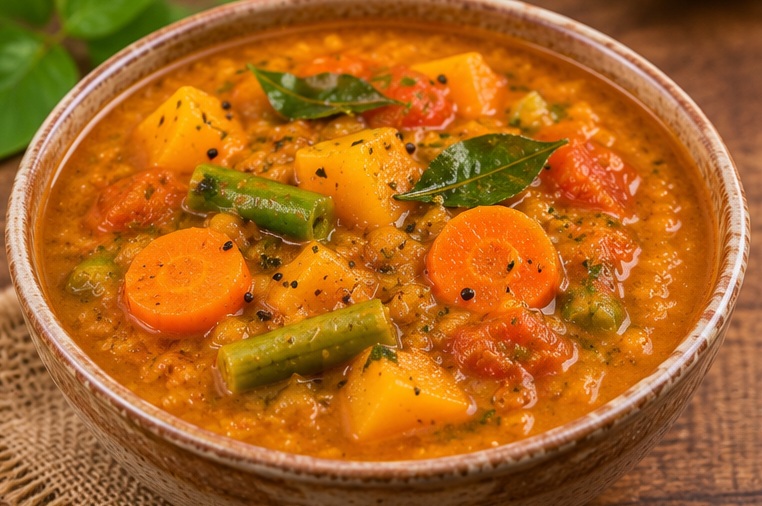
A tangy toor dal and vegetable sambar with tamarind, roasted coriander, cumin and curry leaves, made without onion or garlic.
An independently measured regional adaptation for home prasadam cooking. All listed ingredients omit onion, garlic, eggs and mushrooms. Follow your own temple's guidance for fasting and worship.
Sambar without onion and garlic
Sambar combines cooked pigeon peas (toor dal), tamarind, vegetables and a fragrant spice mixture. This adaptation relies on individual roasted spices instead of a packaged powder that might include onion or garlic. Vegetable combinations and spice ratios vary across South India.
Cook the dal until soft
Tamarind is acidic, so cook the lentils separately until they crush easily before combining them with sour ingredients. Cut firm vegetables evenly and avoid overcooking pumpkin into a paste.
Temper the mustard seeds carefully
Use a dry small pan and dry curry leaves to reduce splattering. Lower the heat before adding the leaves. A brief final tempering provides fragrance without a prolonged frying step.
Bhakti Thought
Regional traditions provide many ways to prepare and share a meal with devotion. Set aside an untouched offering for Krishna before tasting and distribute prasadam with gratitude.
PrintSouth Indian Vegetable Sambar (No Onion or Garlic)
A tangy toor dal and vegetable sambar with tamarind, roasted coriander, cumin and curry leaves, made without onion or garlic.
- Prep Time: 20 minutes
- Cook Time: 45 minutes
- Total Time: 65 minutes
- Yield: 6 servings 1x
- Category: Main course
- Method: Simmering
- Cuisine: Indian regional-inspired
- Diet: Vegan
Ingredients
- 150 g dry split toor dal
- 700 ml drinking water for dal
- 180 g carrot, diced
- 200 g pumpkin, cubed
- 100 g green beans, cut into short lengths
- 150 g ripe tomato, chopped
- 10 g plain seedless tamarind pulp, soaked in 100 ml warm water and strained
- 2 teaspoons coriander seeds
- 1 teaspoon cumin seeds
- 1/4 teaspoon fenugreek seeds
- 1 dried red chili, optional
- 1/2 teaspoon ground turmeric
- 2 teaspoons neutral oil (10 g)
- 1 teaspoon black mustard seeds
- 8–10 fresh curry leaves, washed and dried
- 1/2 teaspoon fine salt, or to preference
US & metric measurements — original 1× batch
Use either measurement, not both. Equivalents are approximate; original specified weights are preserved. Counts, optional quantities and amounts to taste remain as written. This reference is for the original batch; multiply both quantities if scaling the recipe.
150 g (approx. 5.29 oz by weight) dry split toor dal
700 ml (approx. 2.92 US cups) drinking water for dal
180 g (approx. 6.35 oz by weight) carrot, diced
200 g (approx. 7.05 oz by weight) pumpkin, cubed
100 g (approx. 3.53 oz by weight) green beans, cut into short lengths
150 g (approx. 5.29 oz by weight) ripe tomato, chopped
10 g (approx. 0.35 oz by weight) plain seedless tamarind pulp, soaked in 100 ml (approx. 6.67 tbsp) warm water and strained
2 teaspoons (approx. 10 mL) coriander seeds
1 teaspoon (approx. 5 mL) cumin seeds
1/4 teaspoon (approx. 1.25 mL) fenugreek seeds
1 dried red chili, optional
1/2 teaspoon (approx. 2.5 mL) ground turmeric
2 teaspoons neutral oil (10 g)
1 teaspoon (approx. 5 mL) black mustard seeds
8–10 fresh curry leaves, washed and dried
1/2 teaspoon (approx. 2.5 mL) fine salt, or to preference
Approximate kitchen conversions: NIST and ingredient-specific baking weights.
Instructions
- Rinse toor dal. Simmer in measured water until completely soft, about 30–40 minutes, adding water if needed. Mash lightly.
- Dry-toast coriander, cumin, fenugreek and optional chili over gentle heat until fragrant, without scorching. Cool and grind finely.
- In another saucepan simmer carrots, pumpkin and beans in water just sufficient to cover until nearly tender. Add tomato, turmeric, ground spices and strained tamarind.
- Stir in the fully cooked dal and salt. Simmer 8–10 minutes, until vegetables are tender and the consistency is pourable; adjust with water.
- Warm oil in a small pan, add mustard seeds, then dry curry leaves carefully. Stir the tempering into the sambar. Reserve an untouched offering before serving.
Notes
- Contains mustard and pigeon peas (legumes). Verify cross-contact. This is not suitable for grain-and-legume-free Ekadasi.
- Nutrition estimates per stated serving use representative ingredients and include measured optional ingredients; actual values depend on brands and yield. Not kitchen-tested.
- Ingredient quantities and cooking times are editorial estimates; confirm through kitchen testing.
- Nutrition values are estimates per serving unless otherwise specified.
Nutrition
- Serving Size: 1/6 of prepared batch
- Calories: 150
- Sugar: 4 g
- Sodium: 225 mg
- Fat: 3 g
- Saturated Fat: 0.5 g
- Unsaturated Fat: 2 g
- Trans Fat: 0 g
- Carbohydrates: 24 g
- Fiber: 7 g
- Protein: 7 g
- Cholesterol: 0 mg
Serving suggestions
Serve warm over plain rice or beside idli or dosa. Adjust water for a soup-like or thicker serving consistency.
Storage and safe serving
Cool promptly and refrigerate within two hours; use within three days. Reheat until steaming throughout.
Nutrition and allergens
Contains mustard and pigeon peas (legumes). Verify cross-contact. This is not suitable for grain-and-legume-free Ekadasi. Nutrient values are approximate, not laboratory analyses.
Frequently Asked Questions
Can sambar be made without onion and garlic?
Yes. Individual roasted spices, tamarind and curry leaves provide flavor.
Can I use prepared sambar powder?
Only after checking its ingredient list for unsuitable additives and onion or garlic.
Why is my dal still firm?
Cook it thoroughly before adding tamarind; older lentils can take longer.
Is sambar an Ekadasi dish?
No. Toor dal is a legume.
Explore More Recipes
Karnataka Bisi Bele Bath (Tamarind Rice and Toor Dal)